


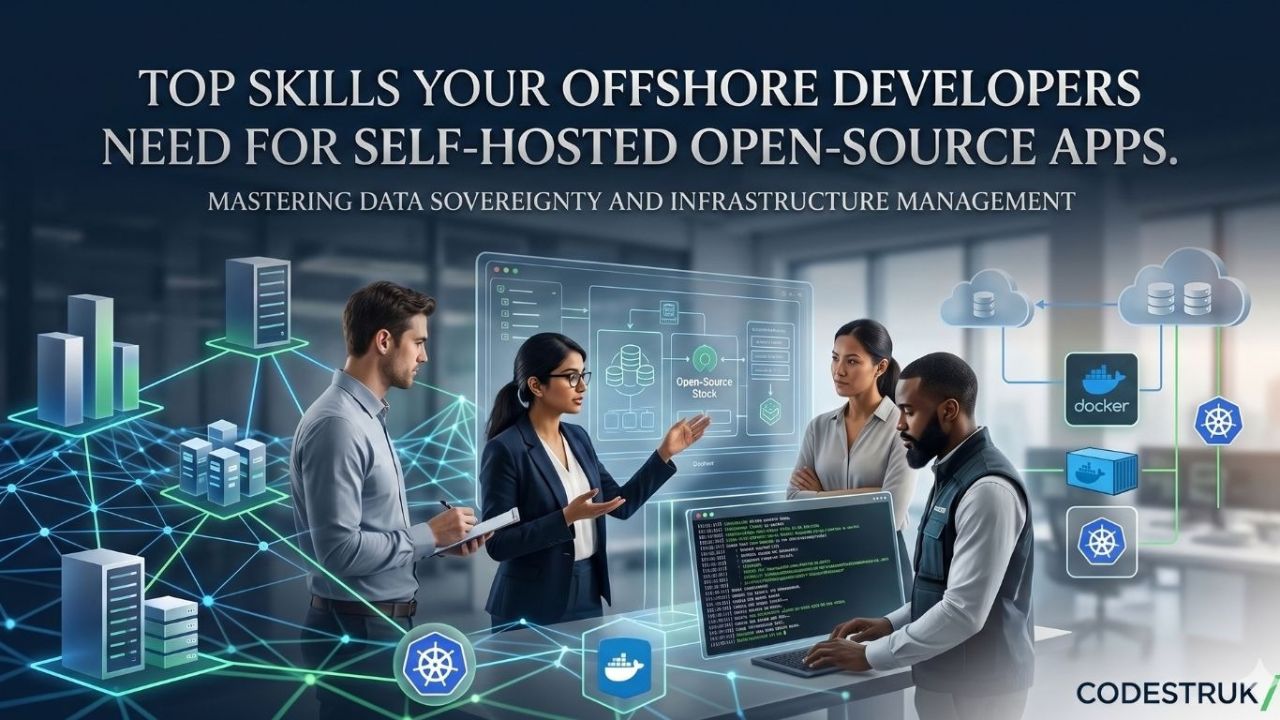
Top Skills Your Offshore Developers Need for Self-Hosted Open-Source Apps


The move towards open source software has irrevocably transformed how modern enterprises construct, scale, and secure their digital presence. Whether self-hosting a privacy-focused analytics service, or your own custom-built PropTech platform on top of open source Large Language Models (LLMs), self-hosting provides absolute control of your data (removing the threat of vendor lock-in) and offers massive savings in long-term SaaS licenses.
Nevertheless, leaving a fully managed cloud service (e.g. Firebase, Supabase, full-stack AWS SaaS) to self-host means that you own and are solely responsible for the entire stack. Once you move to a self-hosted stack your system will only be as reliable as the team designing, developing, and running it.
For many expanding software agencies and enterprises, hiring an offshore team is the most efficient way to scale development. But standard web development experience isn't enough here. To prevent catastrophic data loss, security breaches, or prolonged downtime, you must know the top skills your offshore developers need for self-hosted deployments.
In this comprehensive guide, we will break down the foundational, architectural, and security capabilities required to successfully manage self-hosted open-source applications.
1. Why Self-Hosted Open-Source Infrastructure Demands a Specialized Skill Set
The benefits when developers use third-party, completely managed API's; are huge. Updates to the operating systems, replication of the database, auto back-up of your data, firewall to protect your network and scaling of your system to meet demand is all the job of the cloud provider.
In the self-hosted scenario however, it becomes the job of your team.
If the connection pool to your database bursts open at 3am, there is no third party helpdesk ticket you can raise; you need to fix your configuration, determine why and ensure all the services are running again. Your offshore developer's top skills, in relation to your top skills your offshore developers need for self-hosted model, are a non-negotiable criterion to be discussed before you agree a contract.
2. Core Linux Administration and Bare-Metal Command Line Expertise
All self-hosted open-source apps run on a Linux distro (Ubuntu, Debian, Alpine, or Rocky Linux, etc.) Ultimately. A graphic interface and control panel aren't reliable enough for enterprise level applications for your offshore team to be comfortable and efficient with.
Advanced Shell Scripting & Automation
It's essential your developers be adept with Bash/Zsh scripting. These should be capable of writing automated cron jobs for maintenance, parse gigabytes of logs (grep, awk, sed) and monitor server resources at all times (top, etc.).
Process and Resource Management
There are implications for running complex open source stacks on VPSs and/or bare-metal that kernel level resource allocation is critical. What the offshore developer needs skills for on top skills your offshore developers need for self-hosted infra are:
Systemd-able to create, enable, and debug system services
Resource Monitoring-able to trace CPU usage spikes, memory leaks, and I/O saturation using top, htop, iotop, df.
Permissions and Ownership-able to lock down POSIX permissions (chmod, chown) to mitigate horizontal movement of an exploit from one aspect of the web app into the server itself.
3. Containerization and Orchestration (Docker & Kubernetes)
Today, very few open-source applications will ship with just plain source code, instead they’ll ship with a container. A container makes sure your app will run the same way on dev, staging, and production.
[ Client Request ] > [ Nginx / Reverse Proxy ] > [ Docker Container Network ]
[ Web App Component ] [ Worker / Background Tasks ]
Docker and Docker Compose
At a bare minimum, the offshore developers that you hire must have in-depth knowledge about Docker. They should be adept at writing efficient, multi-stage Dockerfiles with the goal of keeping the image size down and minimizing the attack surface. Furthermore, they must be proficient in using Docker Compose for connecting containers across an application (binding a Next.js front end, a python back end, Redis, and a Postgres db to create an isolated private network).
Production Orchestration
For a mission critical enterprise application that must offer high availability and no downtime updates, container orchestration will become critical. If you decide to scale, then the offshore developers you need for a self-hosted application must have skills in Kubernetes (K8s), Docker Swarm, or Nomad. This includes persistent volume claim (PVC) management, configuring ingress controllers and orchestrating rolling updates.
4. Advanced Networking, Reverse Proxies, and SSL/TLS Management
For a self-hosted infrastructure, robust networking knowledge is necessary for safely routing the public web traffic to the isolated internal container network.
Reverse Proxies and Load Balancers
Your offshore team need the knowledge on setting up reverse proxy like Nginx, Traefik, Caddy; how to create upstream blocks for load balancing, what custom headers should set up in the proxy for better security, how to tune buffer sizes and what common DDoS effect can mitigate by proxy.
Custom Networking Profiles
The awareness of bridge network, host network and overlay network in containerized context is important, below are some necessary skills for your offshore developers in top skills your offshore developers need for self-hosted network: locally map the DNS, manage the internal routing and use VPN or WireGuard to tunnel the internal database port never exposing on public Internet.
5. Automated CI/CD Pipelines for On-Premise Deployments
As a self-hosted system your offshore developers need to create a delivery pipeline from scratch whereas in SaaS systems code deployment is automated by the provider.
Pipeline Architecture from scratch
No matter whether your developers use GitHub actions self-hosted runners, Jenkins or GitLab CI they need to create the delivery pipeline that runs the tests suites automatically, build production-quality container images, push the images to a private container registry and push them on to production servers in a secure way through SSH or through webhooks.
Infrastructure as Code (IaC)
In order to achieve a server state without any configuration drift the offshore team needs to be expert in Infrastructure as Code. Expert usage of Terraform, Ansible or Pulumi is one of the strongest skills for your offshore developers in case of top skills your offshore developers need for self-hosted infrastructure, as this toolset will help you restore your entire server infrastructure within minutes in case of disaster.
6. Comprehensive Database Administration and State Management
If your stateless web container crashes, it's easy to start another one. But if your database gets corrupted or lost, then your business can die. It is much harded managing state.
Database Requirement
Key skills required for developers:
Replication & High Availability
Deploying primary-replica architectures, dealing with connection pooling (e.g.,PgBouncer).
Automating Backups
Scripting automated daily dumps, validating snapshots and replicating them off-site.
Tuning Performance
Optimizing indexes, identifying slow query, managing logs and adjusting cache sizes.
Export to Sheets
The essential skills for developers building self-hosted apps on open-source databases like PostgreSQL, MySQL, MongoDB or Redis include strong architectural DBA skills. The developer must be able to run zero-downtime migrations and PITR procedures successfully.
7. Rigid Security Hardening and Vulnerability Management
When you self-host, you become a prime target for automated script kiddies and Deceptive malicious actors looking for unpatched exposed servers.
Server-Level Hardening
Your developers should know how to completely lock down a Linux machine. It is important to turn off SSH password authentication and instead switch to cryptographic SSH keys, in addition to changing the default management port, enabling automatic firewall rules using UFW or IPTables, and employing intrusion prevention tools like Fail2ban that blacklist suspicious IP addresses.
Application-Level Security
Many open source programs regularly get patches for security vulnerabilities. Your offshore developers need to closely follow CVE (Common Vulnerabilities and Exposures) feeds and have a regular routine of applying patches to the top skills your offshore developers need for self-hosted operating system and the core application images. Security awareness alone is arguably one of the most critical top skills required of offshore developers for self-hosted enterprise web apps.
8. Proactive Monitoring, Logging, and Alerting Ecosystems
If you can't measure it, you can't manage it. To survive the pitfalls of the self-hosted ecosystem, you need to have insight into how healthy your applications are before your customers do.
Distributed Tracing and Metrics Collection
Your offshore developers need to be proficient at deploying and managing sophisticated monitoring stacks such as the Prometheus/Grafana pair, or smaller lightweight stack like Netdata and Glances.
Centralized Log Management
Manually searching log files across 5 different machines is not effective during an outage. Setting up centralized logging such as using the Vector, Loki, and ELK (Elasticsearch, Logstash, Kibana) stacks should be one of the top skills your offshore developers need for self-hosted your offshore developers can bring to the table for a self-hosted setup. This also means setting up thresholds that can send alerts to platforms like Slack, Discord, and PagerDuty in case of spiked resource usage or 5xx server errors.
.
9. Evaluating Technical Competency: Interview Questions for Offshore Teams
In order to ascertain that your potential offshore development partner actually has the practical experience that is needed to maintain a self-hosted infrastructure, avoid the coding challenges. During your evaluation process, question them based on the below scenarios.
Scenario A: The Storage Crunch
"Our self-hosted open source application starts returning file upload errors. Upon login to the system via SSH you find that the main partition of the disk has filled up due to errant logs generated by the application. Explain the immediate actions to restore the services, and how to configure the system in such a way to eliminate any similar occurrences forever".
What to listen for: An explanation for using commands df-h and du-sh, to identify the offenders of the disk space, safely clearing or rotating out the current logs without impacting live processes, and automating log rotation by means of logrotate with disk space thresholds set up within Grafana/Prometheus.
Scenario B: Protecting our Assets
"Our self-hosted backend API container is in need to be connected to the top skills your offshore developers need for self-hosted open source Postgre database container running on the same physical machine. Explain how to setup the networking such that it will not be accessible from outside on the internet".
What to listen for: You'd want an explanation where they create a user-defined isolated bridge network on docker, that both the containers will be connected to, and the Postgre database exposed on its internal port of 5432 only inside the bridge and the host public port remains shut out from the world with the help of a closed firewall. This demonstrates architectural knowledge that you can expect from offshore developers in relation to databases self-hosted by you.
10. The Ultimate Skills Matrix for Vetting Offshore Developers
Streamline your hiring process. Evaluate candidates on their self-hosting capabilities:
[ ] Linux Proficiency: Experience with SSH, systemd, Cron, command-line text manipulation.
[ ] Containerization Knowledge: Extensive Docker, multi-stage Dockerfiles and Compose setup experience.
[ ] Reverse Proxies: Experience writing Nginx/Traefik/Caddy configuration including routing, SSL and rate limiting rules.
[ ] CI/CD proficiency: Ability to architect automation pipelines in a self-hosted way without the use of managed third party cloud deploy UIs.
[ ] Database proficiency: Hands on experience with automated database backups, replication and optimization settings.
[ ] Security hardening knowledge: Hands on experience with deploying SSH keys, configuring UFW/IPTables, implementing Fail2Ban, and regular patching forCVE's.
[ ] Observability stack: Experience with Prometheus, Grafana and/or Loki and automated alert system configuration.
If their team has all of the above, the open source platform could be in safe hands without giving you nightmares about your own infrastructure.
11. Conclusion
A decision to self-host open-source applications is a brilliant, strategic business decision, placing control of your data, infrastructure and financial plans back in the hands of your organization.However,the operational liberty that comes with self-hosting is directly proportional to the skills of your development team. top skills your offshore developers need for self-hosted
Knowing the priority skills that your offshore development team requires to support self-hosted applications turns your engineering department into a cadre of highly efficient infrastructure caretakers. Once you guarantee that your offshore development partner is well-versed in Linux system administration, advanced containerization and sophisticated routing topologies, automated data state management and vigilant security monitoring, your self-hosted applications will scale easily without experiencing down-time.
Do you require an offshore development partner who possesses substantial and hands-on experience designing and managing robust, self-hosted open-source infrastructures? Reach out to Codestruk today and find out how our engineers can scale your infrastructure effectively and securely.
12. Frequently Asked Questions (FAQ)
Q1: Top of the list of essential skills for your offshore developers for self-hosted open-source apps?
Absolutely core essential skills are expert Linux server administration, heavy-duty Docker and containerisation skills, deep understanding of reverse proxy configurations (i.e., Nginx, Traefik), scripting for automated database backup and replication, and hardened, hardened server level security.
Q2: Why isn't a standard full-stack developer able to take care of the self-hosting?
Most standard full-stack developers can rely on SaaS platforms that do all the infra management for you (e.g. Vercel, Heroku, Firebase), but this level of self-hosted deploying requires system-level, DevOps-focused, networking skills, and custom security configuration capabilities beyond simple application code.
Q3: How can you trust that your offshore developers keep their self-hosted open source applications secure?
They close all unnecessary ports, require ssh-key only, harden the systems with firewalls, use intrusion detection such as fail2ban, and monitor for CVE updates to push immediate security updates to the host and the containers.
Q4: What is the number 1 skill set needed for your offshore developers to handle self-hosted database management?
Developers must be able to: take fully automated data dumps, keep snapshot copies stored off-site, model primary-replica database replication strategies, and model and implement connection pooling, and safely automate database migrations and Schema updates.
Q5: How do you make sure your offshore developers have the skills you demand?
Codestruk’s technical interview includes various kinds of practical tasks: live terminal exercises, infrastructure modeling tests, container tuning and a mock incident response in a production-like environment to make sure candidates have the necessary skills.
You May Also Like To Read
Discover more insights, tips, and stories from our expert team


Get In Touch
Let's discuss your project requirements